Hi everyone! I hope you’re all well. Today is Friday, and it’s time for another review. Today, I’m sharing my review of Una McCormack’s Star Trek: Picard prequel tie-in, The Last Best Hope.
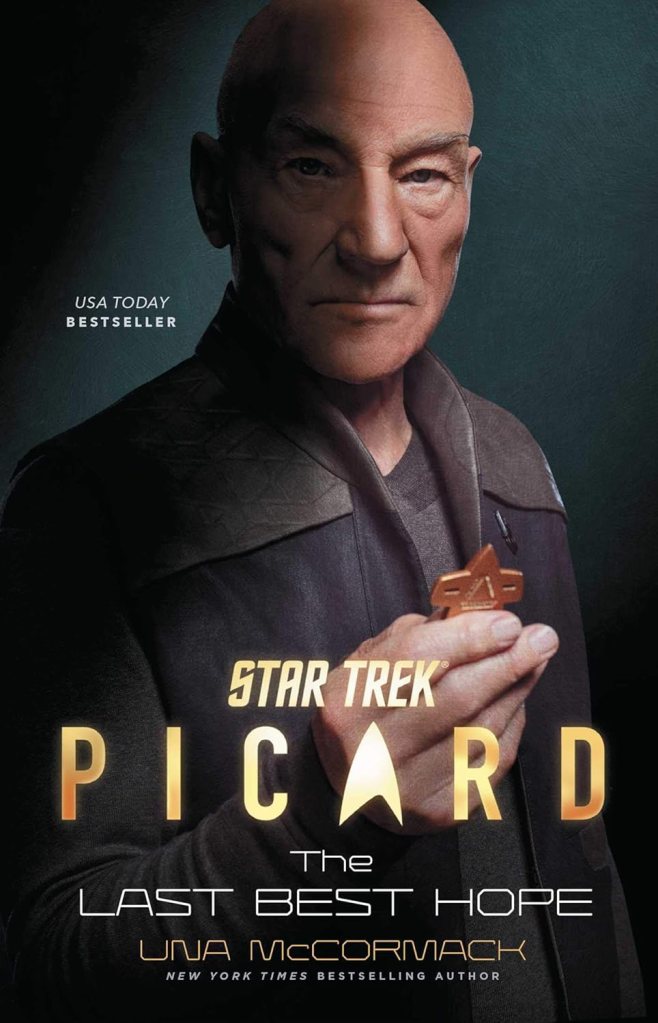
Star Trek: Picard: The Last Best Hope was published in 2020 by Pocket Books and is 335 pages long.
The Plot
Jean-Luc Picard is called upon to lead one of the greatest humanitarian efforts in Federation history: a massive evacuation of Romulan civilians ahead of their sun going supernova. The Romulan Empire faces annihilation, and the Federation must decide whether to extend help to a former enemy. Picard is promoted and placed in charge of coordinating the rescue and relocation mission, which quickly proves to be a staggering logistical challenge with political, cultural, and ethical complications at every turn.
Characters
Jean-Luc Picard
Picard is the centre of the book, and he’s portrayed as absolutely committed to the Romulan rescue — tireless, principled, and sometimes naive about how far those principles will carry him in the face of politics. He’s focused on lives saved, not political capital, and that single-mindedness is both his strength and his blind spot.
We see his optimism slowly erode as compromises accumulate, allies fall away, and Starfleet’s moral core rots under pressure. By the end, his resignation doesn’t feel like a sudden choice; it feels inevitable.
Raffi Musiker
Raffi is arguably the book’s breakout character. McCormack uses the novel to show how deeply Picard’s mission shapes — and wrecks — her life. As Picard’s first officer on the Verity, she’s sharp, intuitive, and unafraid to challenge him. Their professional bond and mutual respect are a highlight of the story.
At the same time, the mission destroys her family: her marriage collapses, her relationship with her son frays, and the constant stress and disappointment push her toward self-destructive coping mechanisms. When Picard walks away from Starfleet, Raffi’s sense of abandonment hits much harder because we’ve watched their camaraderie grow over years.
Bruce Maddox & Agnes Jurati
McCormack also uses the book to set up the Daystrom Institute subplot from the series. We see Bruce Maddox working on synthetic life and mentoring a young Agnes Jurati, with their relationship gradually becoming more personal as well as professional.
Elnor
Elnor appears as a boy on the margins of the evacuation story, and his bond with Picard is seeded with a tenderness the show later relies on. It’s one of the book’s more emotionally effective threads because it makes the later “why did you leave?” question feel personal, not just political.
Doctor Amal Safadi & Doctor Nokim Vritet
These two scientists — one human, one Romulan — add depth to the novel’s geopolitical and scientific dimensions. Their separate efforts to understand and communicate the worsening astrophysical threat highlight the cultural barriers and institutional inertia that stymie meaningful cooperation.
Writing Style
Una McCormack writes tie-in fiction brilliantly. She writes in a straightforward, readable way, never getting bogged down in technobabble, even when discussing the logistics of the evacuation or research on synths.
Her narrative is rich with internal monologue, recorded logs, and strategic deliberations, providing a close view of the characters’ hopes, fears, and doubts. This is not a fast-paced adventure story; it’s more a sombre, layered political and humanitarian drama that mirrors Star Trek’s best science-fiction traditions.
Final Thoughts
Overall, Star Trek: Picard – The Last Best Hope works best as a character and context piece. It explains, with painful clarity, how the Federation we thought we knew became the more compromised organisation we see on screen, and why Jean-Luc Picard — the man who once embodied its ideals — ends up an embittered retiree on a vineyard.
If you’re a Picard viewer who wants more of the political and emotional connective tissue that the show only sketches in, this novel is pretty much essential reading. However, if you’re after phaser-fights and starship battles, it might feel more like a slow, often drawn-out drama — but as a study of ideals under pressure, it’s rather powerful.
I’m giving this one a 9/10.
Have you read The Last Best Hope? Do you think it’s a good lead-in to the Star Trek: Picard TV series?
As ever, thanks for stopping by and reading my review!
Until next time,
George
© 2026 GLT
Categories: Uncategorized


@georgelthomas.com Thanks for the review, much appreciated. Just the title of this book puts me off wanting to read it.
LikeLike
Remote Reply
Original Comment URL
Your Profile
Why do I need to enter my profile?
This site is part of the ⁂ open social web, a network of interconnected social platforms (like Mastodon, Pixelfed, Friendica, and others). Unlike centralized social media, your account lives on a platform of your choice, and you can interact with people across different platforms.
By entering your profile, we can send you to your account where you can complete this action.