
Hi everyone! I hope you’re all well. Today is Friday, and it’s time for another review. This week, I am reviewing the graphic novel Liebestrasse by Greg Lockard, Tim Fish, and Héctor Barros.
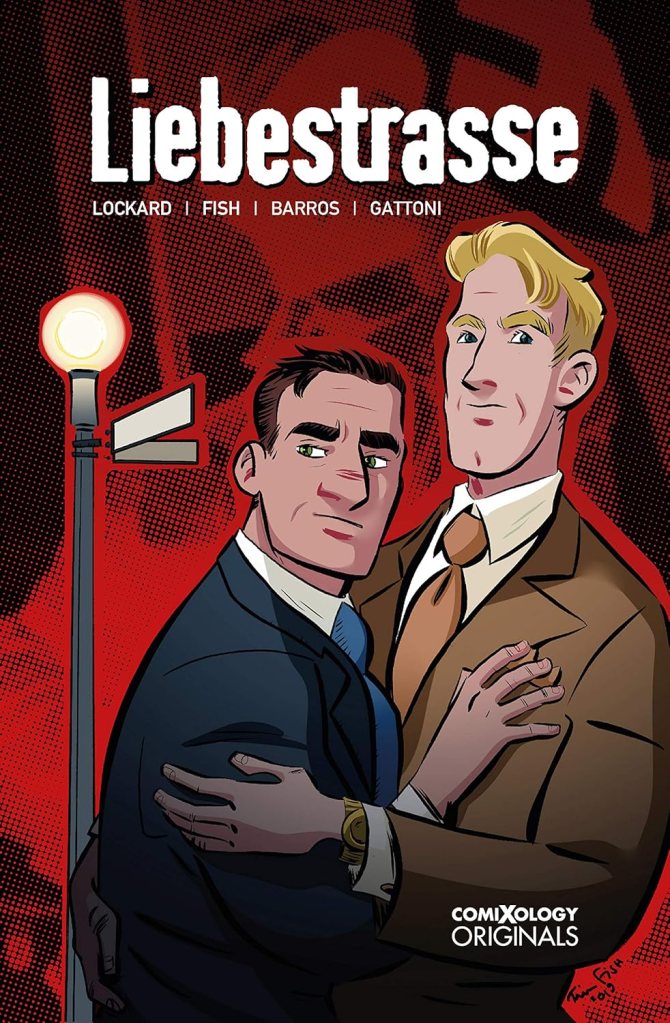
Liebestrasse was published in 2019 by Comixology (online) and Dark Horse (paperback) and is 98 pages long.
The Plot
Set in two timelines, 1932 and 1952 Berlin, the novel begins with Sam Wells, an American banker, who returns to Germany in search of love and closure. Flashing back to his first trip, we meet a young, ambitious Sam navigating Weimar, Berlin’s vibrant gay scene, where he meets Philip Adler, a charismatic German art critic. Their friendship quickly deepens into a tender, forbidden romance, and the story follows them as they try to exist in a world of new and horrific persecution.
Characetrs
Sam Wells
Sam is an earnest, reserved US banker who is sent to Berlin for business. He’s initially cautious but is soon drawn out by the city’s energy when he meets a young man named Philip. The book isn’t that long, and because of that, I can’t say too much about the characters without spoiling the story.
Philip Adler
Philip, in contrast to Sam, is a bold, quick-witted German art dealer who embraces authenticity—both in expression and political stance. He is a vibrant and savvy man who shows Sam around town.
Hilde Adler
Hilde is Philip’s sister. She is an artist who is targeted for her work, some of which is deemed “un-Aryan,” highlighting the rising state of oppression in the country.
Writing Style
Lockard’s writing here is economical yet emotionally rich, incorporating historical details without it feeling like a lecture. The historical detail is woven into character drama with the love story always front-and-centre, even as the rising threat of the Nazis tightens.
The story moves with quiet precision. Minimalistic dialogue and narrative urgency make each moment weighty: early romantic scenes brim with warmth, while later scenes crackle with tension.
Throughout, the dialogue helps distinguish and highlight Sam and Philip’s different cultures and classes: Sam’s measured American nature contrasts with Philip’s playful cosmopolitanism. Lockard also uses dramatic irony to excellent effect—the reader, unlike Sam, knows exactly where Germany is headed, which lends every moment of their time together a tinge of sadness.
My one and only quibble with the story is that I would have loved a bit more in terms of Philip and Hilde’s stories—though, I think if their characters were further explored, the story might have become a bit clunky.
Artwork
Tim Fish’s style leans slightly cartoonish, with a clean retro sensibility. His character expressions convey complex emotions, including flirtation, fear, and resolve—with minimal lines. He ages characters convincingly between timelines, distinguishing the vibrant, hopeful 1930s from the sombre, more reflective 1950s.
Meanwhile, the Colours by Héctor Barros heighten the mood with shifts of pastels for pre-Nazi nightlife, cooler greys and sickly greens as repression closes in, and muted browns in the 1952 sequences. Overall, the book is a vibrant, stunningly visual feast.
Final Thoughts
I loved this book and its brief yet haunting journey. It’s romantic, tentative, and entirely sobering. If you appreciate a good love story (especially those of an LGBTQ nature) set against the backdrop of a historical setting, then this is for you.
I am giving Liebestrasse a 9/10.
Have you read this one? What did you think?
Thank you, as ever, for reading my review.
Until next time,
George
© 2026 GLT
Categories: Book Reviews, Reading


Leave a comment