Hi everyone! I hope you’re all well. Today is Friday, and it’s time for another review. This week, I’m sharing my review of Jennette McCurdy’s memoir, I’m Glad My Mom Died.
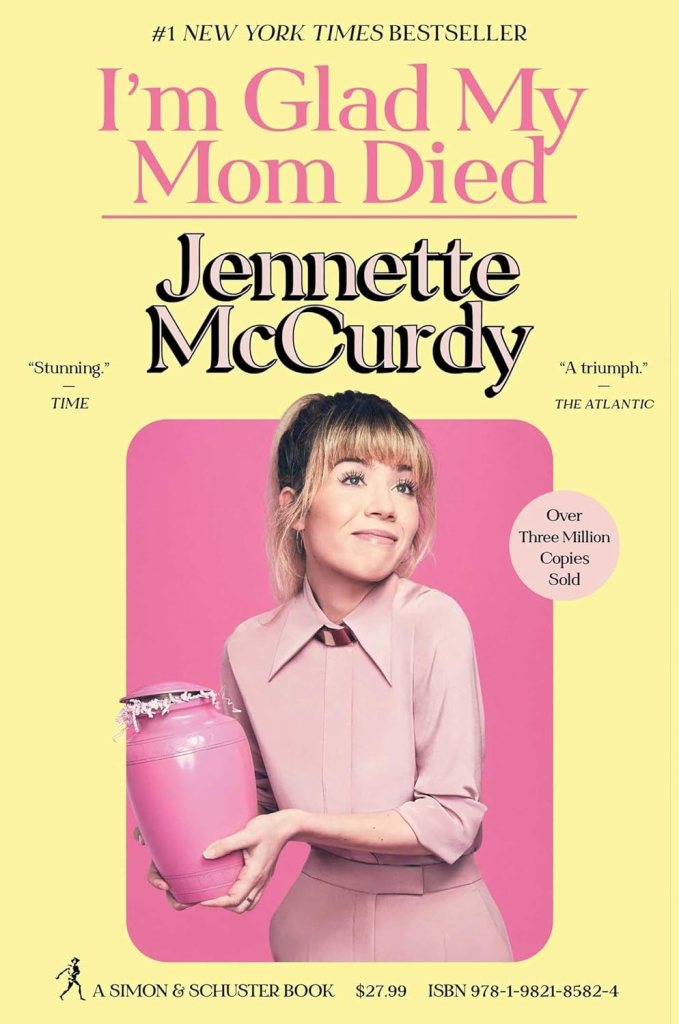
I’m Glad My Mom Died was released by Simon & Schuster in August 2022 and is 320 pages long.
The Plot
This book explores McCurdy’s life from childhood to early adulthood as a child actor best known for her role as Sam Puckett on. At its core, though, this isn’t a showbiz exposé. It’s a psychological autopsy of enmeshment — a relationship so consuming that a child’s identity dissolves inside a parent’s ambition.
Throughout, we follow McCurdy from a childhood shaped entirely by her mother’s fixation on making her a star. Acting lessons, auditions, calorie counting, invasive “health checks,” relentless pressure — all presented as love. Her mother frames everything as sacrifice. Jennette internalises it as obligation.
Characters
Jennette McCurdy
Jennette herself is both narrator and subject. On the page, she is sharp, observant, often darkly funny in a bone-dry way. There’s a childlike literalness in the early chapters that effectively mirrors her upbringing — she reports events without commentary, letting their absurdity and horror speak for themselves.
Debra McCurdy (Mom)
Debra is depicted as the driving force behind Jennette’s acting career, pushing her into the industry at age 6 to fulfil her own unachieved dreams. She is shown monitoring every aspect of Jennette’s life, including showering her, checking her body for lumps, and managing her diet, often controlling her through guilt and fear.
The “Creator”
The “Creator” is an unnamed television producer who symbolises the toxic, exploitative environment in children’stelevision. He is portrayed as having absolute power, creating a dynamic where McCurdy felt trapped, similar to her abusive relationship with her mother.
Writing Style
McCurdy’s prose is straightforward, lean, and deliberately childlike in early chapters. As the memoir moves forward chronologically, the voice matures subtly. This stylistic choice is effective—it allows readers to inhabit the limited worldview of a child who cannot yet name abuse.
The tone blends bleak subject matter with dry, sometimes startling humour. The comedy is not decorative; it functions as a coping mechanism on the page. Scenes about weigh-ins, auditions, and therapy sessions are often delivered with blunt simplicity that heightens their emotional impact.
Structurally, the book progresses in tight, episodic chapters, which keeps the pace brisk, but sometimes at the expense of deeper reflection. Some later sections—particularly those involving recovery and therapy—feel more summarised than explored, as though the memoir is more comfortable depicting harm than unpacking long-term healing.
Final Thoughts
Overall, I’m Glad My Mom Died is brave in its honesty and culturally important in its discussion of coercive parenting and child stardom. It dismantles the myth of the “selfless stage mom” and exposes how ambition can mask abuse. At the same time, the memoir’s emotional restraint and relatively linear structure may leave some readers wanting deeper psychological excavation or greater narrative complexity.
It’s compelling, uncomfortable, and at times bleakly funny — it’s a memoir that prioritises candour over sentimentality. It’s not flawless, but it is undeniably powerful.
I’m giving this one a 7/10.
Have you read I’m Glad My Mom Died? What did you think?
As ever, thanks for stopping by and reading my review!
Until next time,
George
© 2026 GLT
Categories: Book Reviews, Reading


Leave a comment