
Hi everyone! I hope you’re all well. Today is Friday, and it’s time for another review. This week, I’m sharing my review of the 5-issue comic book mini series Star Trek: Voyager: Homecoming by Tilly Bridges, Susan Bridges, Angel Hernandez, Charlie Kirchoff and Neil Uyetake.
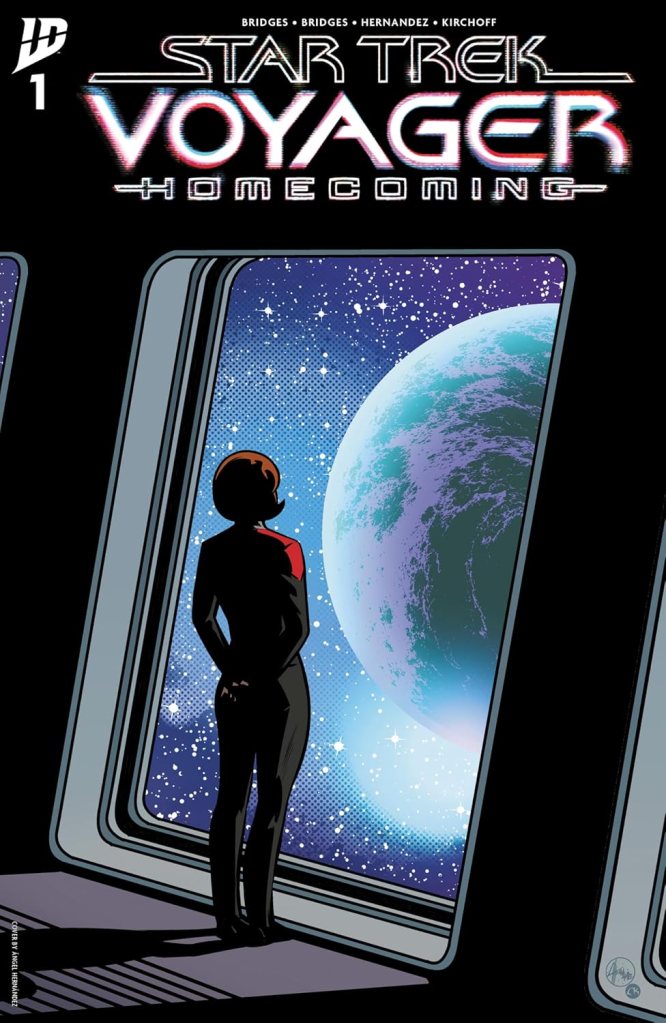
Star Trek: Voyager: Homecoming was published in comic book form, released monthly by IDW Publishing from September 2025 to February 2026. Each issue is approximately 32 pages long.
The Plot
The story begins just moments after the final scene of the Voyager finale “Endgame” — the ship has finally made it back to the Alpha Quadrant and is approaching Earth. But rather than a quiet reunion, the crew is immediately thrust back into danger. A deadly secret emerges as insurgents hidden aboard the ship betray the Voyager and her crew, who, before long, find themselves caught in a web of threats that pull them far from home once more.
Characters
Kathryn Janeway
Janeway is written as a blend of scientist, strategist, and stubborn moralist. She grapples with the consequences of past decisions—especially her bargaining with the Borg in the Species 8472 conflict—and is put in the position of once again“choosing the least terrible option.”
Seven of Nine
Seven gets some of the richest new material; her alliance with the odd Borg enclave in fluidic space allows the book to explore post-Collective identity from a new angle—especially through her connection with the drone Nine, a relationship that acknowledges Seven’s queerness.
Chakotay
As always, Chakotay serves as Janeway’s steady emotional counterweight: grounding her worst impulses, backing her gambles, and raising the occasional ethical objection. His scenes aren’t as radically re-imagined as Seven’s, but his presence helps the book feel authentically “Voyager.”
Tuvok
A crucial subplot involves Tuvok’s accelerated disease and a desperate race to return him to his family in time, a storyline that deepens the personal stakes beyond mere cosmic adventure.
Tom Paris & B’Elanna Torres
Tom and B’Elanna are thrust into parenthood and then immediately into a conflict with Species 8472. Immediately, B’Elanna’s maternal instincts kick in, and she gets right to work, intent on protecting baby Miral. Likewise, Tom steps into protective father mode and even pilots the ship with the baby strapped to his chest.
The Doctor
The Doctor provides comic relief and moral commentary in equal measure. He works with the crew on making a supply of nanoprobes to help fight off Species 8472.
Harry Kim
Poor Harry is, as usual, the earnest, overworked junior officer—but the story gives him moments of competence and leadership, instead of making him a running joke. The push-pull between his eagerness to get home and his duty in fluidic space helps keep the stakes grounded.
Species 8472 & the Rebel Faction
The 8472 threat is more nuanced this time. There’s still a ruthless, revenge-driven commander hunting Voyager—but the rebel faction (fronted by Academy-groundskeeper persona Boothby and his comrade Archer) reframes the conflict as a civil war over how to deal with the humans. That twist stops the story from reducing 8472 to just another capture and escape story and lets Janeway’s diplomacy matter as much as her phaser banks.
Nine (the Borg drone)
Nine is a standout new character; she’s an individualistic drone who, along with others, is severed from the Borg Collective in fluidic space and develops an attraction and connection with Seven.
Writing Style
Tilly and Susan Bridges wear their fandom proudly — but they also know how to tell a strong sci-fi story. The scripting balances nostalgia with narrative momentum. It doesn’t dwell unnecessarily on exposition; instead, it thrusts readers into the drama, trusting that they know these characters and care about them. Yet when emotional beats matter — like Tuvok’spersonal crisis or Janeway’s moral reckoning — the dialogue carries real impact.
The overall plot is well thought out and compelling, and the script feels more like a teleplay than a comic book, with dialogue and pacing in particular having a similar momentum to a television episode. It’s brisk, emotionally direct, and full of character beats that feel authentic to these long‑familiar personalities.
Artwork
Artist Angel Hernandez’s visuals have both the kinetic energy of space conflict and the emotional nuance of the characters’ expressions. The storytelling in panels feels cinematic, with dramatic action sequences giving way to introspective close‑ups, which brilliantly reinforce the narrative stakes.
Colourist Charlie Kirchoff complements the line work with rich palettes that make interdimensional landscapes like Fluidic Space feel alien but believable, heightening contrast in the more dramatic confrontations—while letterer Neil Uyetake’s contribution ties together the pacing and readability of the comic, expertly bringing a balance that helps tie everything together.
Final Thoughts
Star Trek: Voyager: Homecoming is a satisfying extension of the Voyager saga for long-time fans, giving our favourite characters one last harrowing journey before a true homecoming.
It also helps to fill a narrative gap in properly concluding the final episode’s story, something many of us Voyager fans have longed for since the series’ end. Here, we are treated to another interpretation of what happens next for the crew (next to the novel continuation, also called Homecoming, which tells a different homecoming story).
I loved this, and I’m givingit full marks of 10/10.
Have you read Star Trek: Voyager: Homecoming? Did you think it provides a more satisfying end than Endgame (the series finale)?
As ever, thanks for stopping by and reading my review!
Until next time,
George
© 2026 GLT
Categories: Book Reviews, Reading


Leave a comment