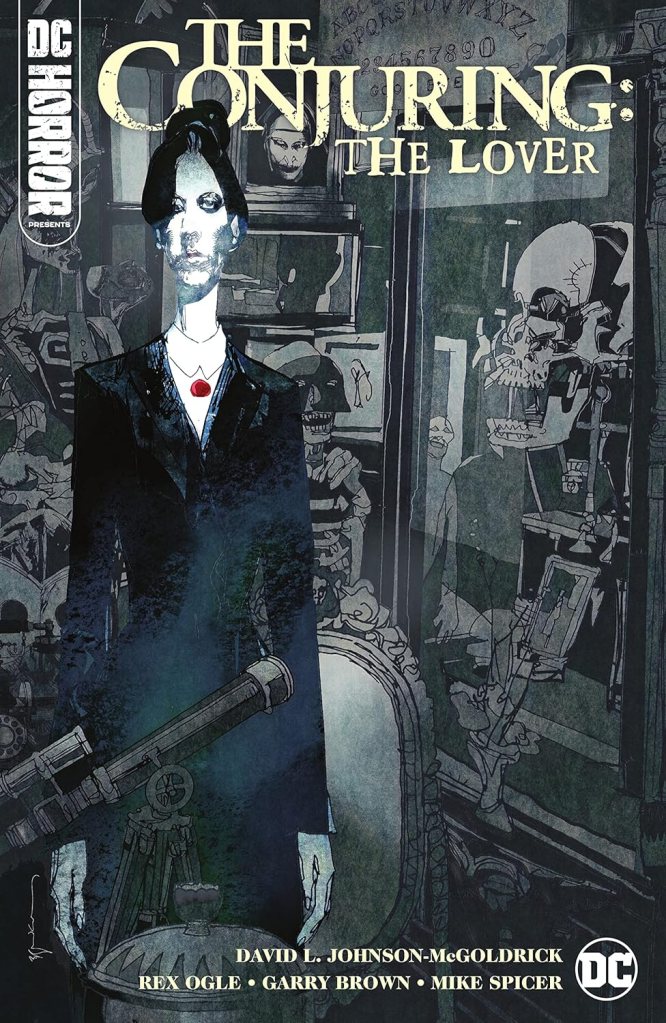
Hi everyone! I hope you’re all well. Today is Friday, and it’s time for another review. This week, I’m sharing my review of the graphic novel, The Conjuring: The Lover by David L. Johnson-McGoldrick, Rex Ogle, Garry Brown, Mike Spicer and Becca Carey.
The Conjuring: The Lover was originally published in its full collected form in 2021 by DC Comics and is 137 pages long.
The Plot
The book serves as a prequel to the 2021 film The Conjuring: The Devil Made Me Do It, and tells the story of Jessica, a freshman returning to Danvers University in 1981 after winter break. She’s juggling poor grades, homesickness, social awkwardness, and regret over sleeping with a boy she now wants to avoid, all while battling the sinking feeling that something is watching her.
As the story progresses, Jessica begins experiencing disturbing hallucinations and increasingly aggressive “nudges” from a demonic presence that feeds on her guilt and insecurity. Her world contracts: friendships fade, her relationship with her mother frays, and the line between reality and supernatural manipulation blurs.
Characters
Jessica
Jessica is the core of the book, and could be a compelling character. She’s a queer, anxious young woman trying to keep her life from unravelling under academic pressure, social expectations, and an unnamed sense of dread. We learn about her childhood friend Katie, her complicated feelings for her, and the way that guilt and repression become perfect footholds for demonic influence.
The issue is that most of this is revealed in blunt strokes or late-stage “twists” rather than being earnedthrough layered development. Jessica often reads more like a checklist of vulnerabilities than a fully realised person, which softens the emotional impact when things finally go very wrong.
Jessica’s Mother
Jessica’s mother appears early as a grounding presence, offering a glimpse of normal life. There are hints of a loving but conservative upbringing that could have deepened the themes of shame and repression, but the book doesn’t really mine that vein.
Katie
Katie is Jessica’s childhood friend and exists primarily at the edges of the story in phone calls, memories, and, mostly, a looming absence. She’s ostensibly crucial to Jessica’s emotional life and eventual breakdown—but the book doesn’t give her enough on-page time to make their relationship truly resonate. When we do finally understand the depth of Jessica’sfeelings, it’s more plot device than catharsis.
The Entity
The entity stalking Jessica is effectively creepy at first—glimpsed in the background, leaning over her shoulder in quiet panels—but as the story goes on, it settles into fairly standard demonic-puppetmaster territory. Fans of the film will recognise some elements—but on the page, the villain never develops much personality beyond being a “malevolent force.”
Writing Style
The writing by Johnson-McGoldrick and Ogle aims for psychological horror grounded in emotional abuse. That’s a potent combination on paper. At its best, the dialogue captures moments of subtle manipulation and gaslighting. However, the script frequently relies on familiar horror beats without deepening them.
There’s a sense that the narrative is constrained by its role as a prequel. It gestures toward bigger lore rather than standing confidently as its own story. The horror feels procedural rather than visceral, and emotional revelations often arrive too quickly to have an impact.
Artwork
Garry Brown’s art is arguably the strongest part of the book. His linework carries a gritty realism that suits the grounded tone of The Conjuring universe. Facial expressions are expressive and often convey more emotion than the dialogue does.
Also, Mike Spicer’s colours lean heavily into muted, shadowed palettes of greens, greys, and sickly yellows, which help build atmosphere. Certain panels genuinely evoke dread, particularly in quieter scenes where the lighting creates a sense of claustrophobia.
However, some action sequences feel visually cramped, and supernatural moments occasionally lack the visual escalation needed to make them land with impact. The horror imagery is good but rarely striking.
Finally, Becca Carey’s lettering is clean and readable even when the panels get visually dense. The SFX and balloon placement keep the pages flowing, which matters in horror, where timing is everything.
Final Thoughts
Overall, The Conjuring: The Lover has a few genuinely creepy sequences, and it sometimes conveys a strong horror atmosphere, but the overall story feels thin, repetitive, and more interested in torment than transformation. If you’rea Conjuring completist, it’s a serviceable companion piece. However, if you want a graphic novel that delivers a satisfying horror narrative on its own terms, this one may leave you feeling… haunted by missed potential.
I‘m giving this one a 3/10.
Have you read The Conjuring: The Lover? What did you think?
As ever, thanks for stopping by and reading my review!
Until next time,
George
© 2026 GLT
Categories: Book Reviews, Reading


Leave a Reply