
Hi everyone! I hope you’re all well. Today is Friday, and it’s time for another review. This time, I’m reviewing the classic children’s novel, Old Yeller by Fred Gipson.
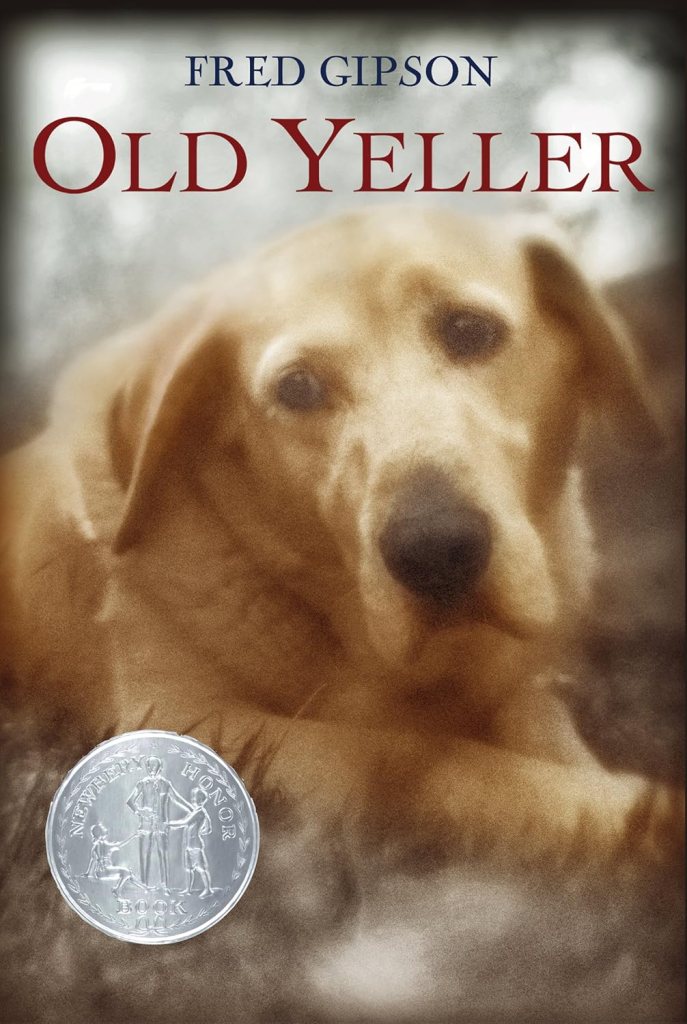
Old Yeller was published by Harper & Brothers in 1956 and is 158 pages long.
The Plot
The story is narrated by fourteen-year-old Travis, who lives with his mother and younger brother on a frontier homestead in Texas. Travis’s father leaves for a long cattle drive, putting Travis “in charge” of the family and farm—a heavy responsibility for a boy who suddenly has to act like a man.
When a stray dog appears on the farm—scruffy, yellow, and full of mischief—Travis is reluctant to accept him. But over time, the dog, soon dubbed Old Yeller, proves his worth. He saves the family from wild animals, helps herd the cattle, and forms a deep bond with Travis. However, the dangers of frontier life escalate, and when rabies begins to spread through the area, tragedy looms.
Characters
Travis Coates
Travis is the protagonist and narrator. At the beginning, he’s proud, stubborn, and eager to prove himself, but his sense of “being a man” is still naive. Through the story, he learns that real maturity means more than being strong or brave; it also means dealing with heartbreak, making impossible decisions, and caring for others even when it hurts.
Old Yeller
Old Yeller is a big, yellow, ragged-looking stray dog with a knack for trouble and an even greater knack for heroism. He’s greedy for food, a bit of a scoundrel, and completely lovable. More than just a “good dog,” Old Yeller represents loyalty, sacrifice, and the imperfect, earthy kind of love that exists in real families. He protects the Coates family from bears, wolves, wild hogs, and cattle, ultimately giving his life to save them.
Arliss (Little Arliss) Coates
Little Arliss is Travis’s younger brother. He’s wild-tempered, impulsive, and fiercely attached to Old Yeller from the moment he appears. Arliss serves as a contrast to the more serious, duty-bound Travis: he embodies childhood in all its chaos and emotional honesty. His devotion to Old Yeller is one of the reasons Travis eventually accepts the dog.
Mama
Travis’s mother is practical, strong, and quietly loving. She manages the household and supports Travis as he takes on more responsibilities, guiding him but also giving him space to learn. Her compassion and resilience are a stabilising force, and she trusts Travis in crucial moments, which reinforces his sense of duty—and the weight of it.
Papa
Although Papa is absent for much of the book, his presence is felt through Travis’s memories and the values he has passed on. When he returns, he provides emotional clarity in the aftermath of Old Yeller’s death. His talk with Travis about pain, loss, and learning to love again is one of the most impactful scenes in the book.
Bud Searcy & Lisbeth Searcy
Bud is a somewhat comic neighbour who doesn’t do much work himself. His granddaughter Lisbeth is observant, kind, and quietly helpful. Her sensitivity and small gestures of kindness (like her role in giving Travis a new puppy) show another side of human connection and empathy.
Writing Style
Fred Gipson’s writing style in Old Yeller is straightforward, vivid, and grounded in the rhythms of rural Texas speech.
The narration uses colloquial language that fits Travis’s point of view—a boy raised on a Texas homestead. Gipson utilises regional expressions and vocabulary, giving the story authenticity without making it unreadable or overly dense. It feels like listening to a story told aloud by someone who lived it.
On the whole, the prose is descriptive without being flowery. Gipson gives us sharp, concrete images: the dust, the heat, the animals, the work of chopping wood, milking cows, and hunting. Action scenes—like the wild hog hunt or the rabid wolf attack—are tense and clearly thought out, making them easy to picture and emotionally gripping.
The book moves in self-contained episodes (bear, bulls, hogs, wolf) that escalate responsibility and danger. Each trial recalibrates Travis’s understanding of manhood, culminating in the rabies arc.
Perhaps most importantly, the tone is unflinching. Gipson doesn’t shy away from the hard truths of life, such as illness, death, and moral responsibility. Yet he balances this with moments of humour, love, and resilience, giving the story emotional weight without despair.
Final Thoughts
Overall, Old Yeller is more than just a “boy and his dog” story. It’s a profound meditation on growing up, set against the unforgiving beauty of the American frontier. Fred Gipson’s novel remains a powerful work of literature that continues to teach empathy, courage, and the cost of real love.
Whether you’re reading it for the first time or revisiting it after many years, Old Yeller is a book that stays with you—much like the memory of a beloved dog who once changed your life. I know what that’s like.
This book will make you feel all the emotions. So be warned.
I’m giving Old Yeller an 8/10.
Have you read Old Yeller or watched the film adaptation? What did you think?
As ever, thank you for stopping by to read my review.
Until next time,
George
© 2026 GLT
Categories: Book Reviews, Reading


Leave a Reply