Hi everyone! How are you all? Today, I am sharing some quick tips for creating and fleshing out your story’s antagonist.
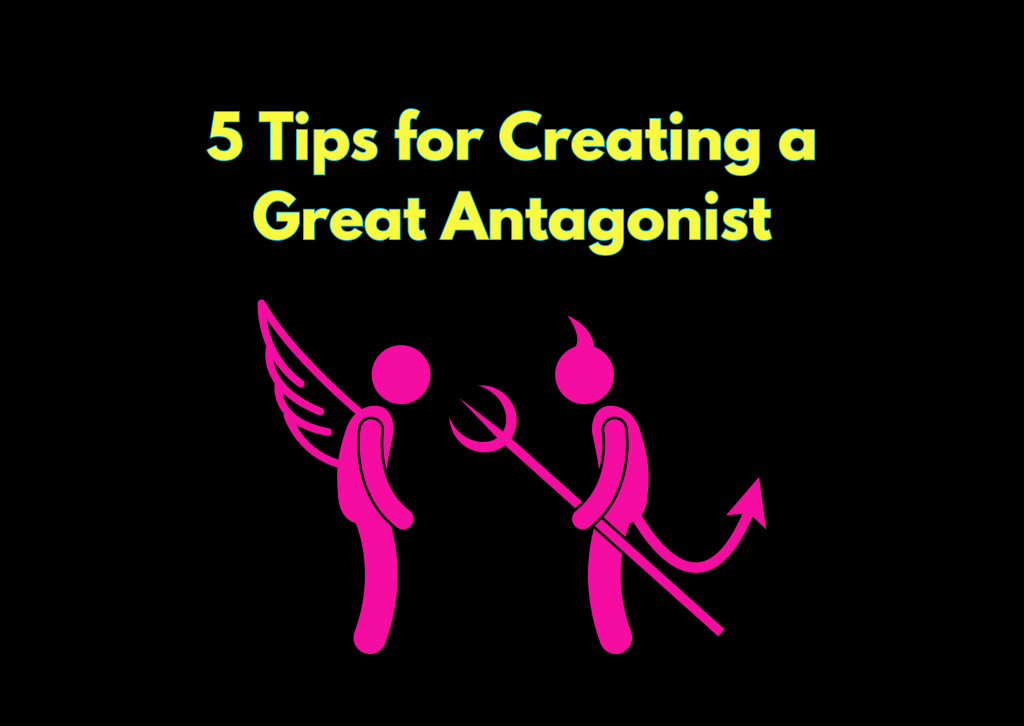
5 Tips for Creating a Great Antagonist
As a vital component of any compelling narrative, the antagonist plays a pivotal role in providing conflict and helping to drive the plot forward.
Creating a great antagonist can be challenging, but with the right approach, it’s possible to produce well-rounded and memorable characters that readers will love to hate. So, with all that said, here are 5 Tips for Creating a Great Antagonist.
1 Round them Out
As with any character, it’s essential to understand that a great antagonist needs to be more than just one-dimensional. Effective antagonists are nuanced characters with their own motivations, strengths, and weaknesses. They should also be relatable in some way, whether through their actions, beliefs, or personal history. By providing depth to an antagonist, readers will be more invested in them and their role in the plot.
2 Give them Some Purpose
Another key strategy in developing your antagonist is to give them a strong sense of purpose. Again, just as the good guys do, the bad guys should have clear goals and desires with reasons for pursuing them. This can be linked to their personal motivations or driven by external factors like a sense of duty or obligation. Regardless, a clear sense of purpose will help readers understand why the antagonist acts the way they do while creating a sense of tension as they work against the protagonist.
3 Humanize Them
A handy tip to remember is that antagonists, for the most part, do not see themselves as such. Often, they feel misunderstood – something most of us can relate to. It’s essential to give your readers a reason to care about them, and this can be achieved through exploring their backstories, personality or moral code.
By humanizing the antagonist, the audience will understand the reasons behind their actions and behaviour and perhaps even why they feel misunderstood. This can be particularly effective if the antagonist is a sympathetic character, forced to act against their better judgment.
4 Make them a Real Challenge
The antagonist must present a real challenge to the protagonist; after all, the interactions between the two will cause much, if not most, of the tension in your story. This could be in the form of a particular set of skills, supernatural abilities, or cunning intelligence. A villain that isn’t difficult to overcome will leave the reader disappointed, disengaged and, worst of all, bored.
5 Avoid Clichés and Stereotypes
A stereotypical villain, such as the mad scientist or the evil queen, lacks depth and can harm your story’s credibility. When you create an antagonist, steer clear of clichés and stereotypes. Instead, break the mould and create a unique, original character that resonates with your readers. If you stick with stereotypes, your readers will probably be able to predict your antagonist’s actions.
All in all, creating a great antagonist is an intricate process that needs careful thought and planning. By developing a character with depth, purpose, agency, and a strong relationship with the protagonist, you are creating an antagonist that will stand out in the minds of your readers.
Thank you, as ever, for reading today’s post. I really appreciate it!
Until next time,
George
© 2024 GLT
Categories: Characters, Writing Tips
 GEORGE L THOMAS
I really enjoyed your post! One of tips that really stood out to me was tip number 4. My dad loves a good antagonist. In fact, some of his favorite characters are antagonists. He always says that the better the antagonist, the better the protagonist, especially if the protagonist is hard to beat. It makes the protagonist look really good in the end when the antagonist is finally taken down. Another tip you mentioned that really stuck out to me was tip 3: humanize the antagonist. I particularly like antagonists who have the same goals as the protagonist, but just have a different way of going about reaching their goals. X men is a good example. Both Professor X, the protagonist, and Magneto, the antagonist, want to help their people. You can sympathize with both. They just have different ideas on how to help their people. Professor X wants harmony between his people and the rest of the world and Magneto wants his people to dominate. I don’t agree with the way with the way Magneto is trying to get his people accepted by society but I do agree that his people shouldn’t have to live in fear and be oppressed. That is good writing! Thankyou for your very interesting post!
LikeLiked by 1 person
Thank you so much, Charli! I agree wholeheartedly with your dad!
LikeLiked by 1 person
Woah!!! These are good tips to create a great antagonist. So far, my antagonist are quite mild. They are just baddies not evil people. I do want to create an evil one the future. Thank you for sharing.
LikeLiked by 1 person
No, Fadima, thank you for the comment! 🙂
LikeLike