Hi everyone! I hope you’re all well. It’s Friday, and it’s time for another review. Today, I am reviewing the graphic novel Maus by Art Spiegelman.
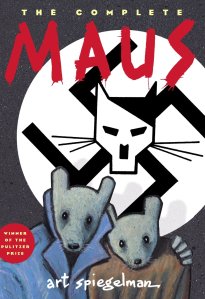
Maus was first published as a seria from 1980 to 1991 before it’s first of two volumes were com[piled and released by Pantheon Books. It is 296 pages long.
The Plot
Maus is a graphic novel and a powerful and poignant memoir that recounts the experiences of the author’s father, Vladek Spiegelman, as a Jewish survivor of the Holocaust.
Characters
Art Spiegelman:
The author and illustrator of the graphic novel, Art, is also a character in the book, serving as a mediator between his father and himself as he tries to understand his father’s past and preserve his story.
Vladek Spiegelman
Vladek is the story’s main protagonist, and it’s narrated from his perspective. He is a Polish Jew who barely survived the Holocaust, having been imprisoned in the Auschwitz and Dachau concentration camps. He is portrayed as meticulous and resourceful and occasionally trades and bribes his way out of dangerous situations to survive. Vladek’s story is one of trauma, loss, and survival, and his relationship with his son Art is strained throughout the book due to the lingering effects of his experiences during the war.
For me, the depiction of Vladek is the book’s main strength. He is shown as heroic and flawed, with his actions in the past being influenced by his stubbornness and need for survival.
He is a complex character – as most real people are, with his personality and behaviour often difficult to understand. He even sometimes comes across as selfish and cruel. However, Art Spiegelman’s portrayal of their interactions allows readers to see the deeper motivations behind these behaviours and to appreciate the intricate and often fraught dynamics between their generations.
Anja Spiegelman:
Anja is Art’s deceased mother, and she was also a Holocaust survivor who tragically committed suicide when Art was young. Although in flashbacks, she is shown as a nurturing and loving mother, her experiences at Auschwitz also left her with deep psychological scars. Anja is painted as a profoundly emotional and fragile person who suffered poor mental health even before the awful atrocities inflicted upon her during the war.
Her story highlights the impact that the Holocaust had on the mental health of survivors.
Richieu Spiegelman
Richieu is Vladek’s and Anja’s first son, who died during the Holocaust while he was still small. His fate was upsetting to read about, and his absence from the story is a poignant reminder of the devastating impact of the Holocaust on families.
Mala Spiegelman
Mala is Vladek’s second wife, whom he married after Anja’s death. Their relationship is strained, with Mala feeling that Vladek is too controlling and frugal with his money. Meanwhile, Vladek doesn’t understand why she wants to spend it.
Françoise
Françoise is Art’s wife. She is a French woman who converted to Judaism when they married. She is portrayed as supportive and understanding and helps Art look after his father in his later life.
Writing Style
What sets Maus apart from other Holocaust narratives is Spiegelman’s unflinching portrayal of the horrors of genocide. He depicts the brutal reality of concentration camps, the psychological trauma suffered by survivors, namely his parents, and the difficulties faced by those trying to rebuild their lives in the wake of such tremendous loss. The narrative is frank and unapologetic but also touching and heartfelt.
The story is a brutal reminder of the incomprehensible horrors of the Holocaust and their enduring impact on the survivors. Vladek’s memories of his experiences in Auschwitz and other concentration camps are harrowing but told with a matter-of-factness that serves to underscore the gravity of what he endured. Spiegelman skillfully weaves together past and present, illustrating the inter-generational effects of trauma and the complex dynamics between a father and son.
Artwork
The artwork in Maus is brilliantly done, and Spiegelman’s use of black and white colour contrasts helps to blunt the knife of awful truth you’re presented with when reading the story. His drawing style is minimalist yet evocative and effective in capturing the raw intensity of the characters’ emotions, whilst the characters and settings are depicted in a way that skillfully draws the reader into the darkness and brutality of war and its horrific consequences.
Final Thoughts
Maus is a masterpiece of the graphic novel genre and a must-read for anyone interested in the Holocaust, memoirs, or graphic novels. It is an intensely moving work that is, at times, challenging but ultimately triumphant, speaking to the strength of the human spirit in the face of unimaginable hardship.
The novel is well-researched, detailed, and beautifully illustrated, offering readers a meaningful and unforgettable experience. For these reasons, I highly recommend Maus to any reader who seeks to expand their horizons and better understand the historical, social, and psychological impact of the Holocaust and its survivors.
I am giving Maus a solid 10/10.
Have you read Maus? What are your thoughts?
Thank you, as always, for reading my review. I really appreciate it!
Until next time,
George
© 2024 GLT
Categories: Book Reviews, Reading
 GEORGE L THOMAS
I have not read Maus, but first heard about it when it became a banned/restricted book in a school district in the U.S. (I think in Tennessee). From what I have read about it, and your review confirms this, is that it’s a very important graphic novel for all to read. It may be a hard topic, but it’s essential we do not turn away from the realities of this part of human history. This is a must-read!
LikeLiked by 1 person
Yes, Molly! I agree 100 percent! 🙂🙂
LikeLike