Hi everyone! I hope you’re all well. Today is Friday, and it’s time for another review. Today, I’m sharing my review of Roald Dahl’s The Magic Finger.
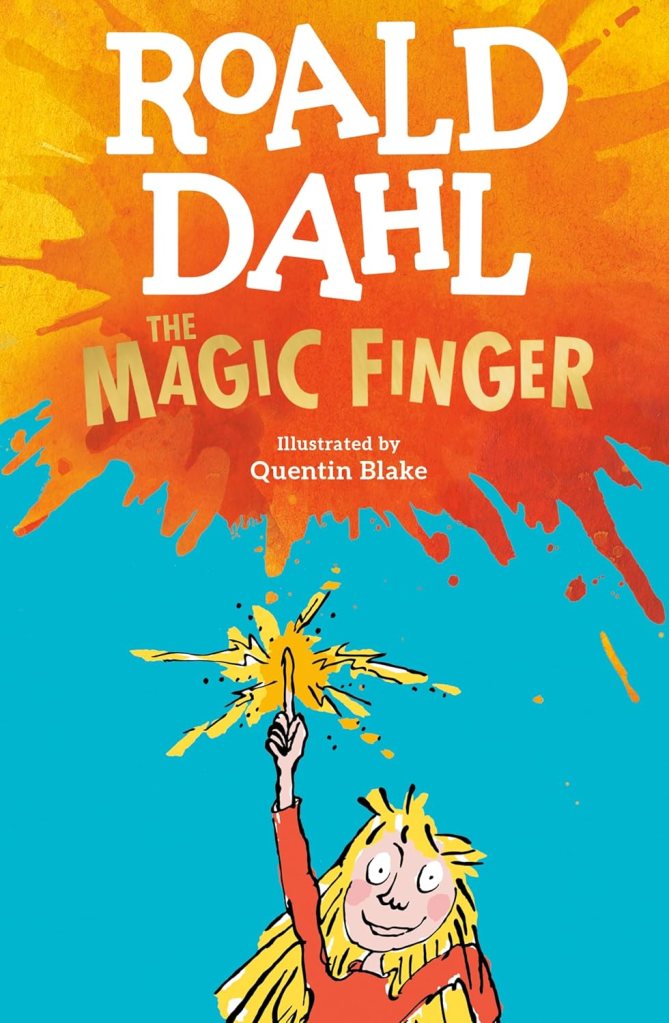
The Magic Finger was initially published in 1966 by George Allen and Unwin in the UK and is 64 pages long.
The Plot
The Magic Finger is a quirky and imaginative tale narrated by an unnamed girl who possesses a mysterious power: when she gets angry, her “magic finger” activates, and strange, transformative things happen to the people who upset her.
Characters
The Narrator
The young girl telling the story is confident, outspoken, and deeply sensitive to injustice. She doesn’t see her magic finger as a gift and wishes she could control it. Her moral compass is strong, and while she causes the story’s central upheaval, she never acts out of cruelty—only outrage at the cruelty she sees in others.
Mr Gregg
Mr Gregg is the patriarch of the Gregg family. He’s proud of his hunting skill and initially very dismissive of the girl’sobjections. He embodies the casual, unthinking cruelty of hunting purely for sport: he shoots deer and ducks because he enjoys it, not because he needs the meat. When he experiences fear and helplessness as a “duck-person,” he finally understands the suffering he’s caused and vows to stop hunting.
Mrs Gregg
Mrs Gregg is supportive of her husband and sons’ hobby at first, but she becomes the most panicked once they’retransformed. She’s protective of her boys, pleading with the ducks to spare them. Her fear helps underline the moral reversal: she’s suddenly forced into the role that grieving animal parents normally occupy.
Philip and William Gregg
Philip and William are the Greggs’ sons, who initially tease the narrator and enjoy going out with their father to shoot animals. They start as typical cheeky boys, but after their ordeal of sleeping in a tree and the threat of being shot themselves, they become more empathetic and ashamed of their past behaviour. By the end of the story, they’re feeding ducks instead of killing them.
The Ducks (especially Mother Duck)
The Greggs used to hunt the Duck family, but in the magical role-reversal, four of them grow human arms and hands and take over the Gregg house—guns included. The most striking figure is the mother duck, who refuses to handle a gun herself and instead forces the Greggs to confront what they’ve done to her children.
The Cooper Family
The Coopers are another hunting family, only mentioned at the end. We never meet them properly; they exist as a looming“next chapter” for the Magic Finger. Their inclusion makes the story feel larger than one episode: there will always be another person who needs a lesson.
Writing Style
Roald Dahl’s writing in The Magic Finger is spare, fast-moving, and perfectly tuned to younger readers. The sentences are short and direct, but loaded with implication, and he trusts children to understand moral complexity without spelling it out.
The tone balances humour and menace. For example, the transformation of the Gregg family is unsettling, but never terrifying; the comedy softens the darkness just enough to keep the story playful, while still meaningful.
Dahl’s trademark child-centred perspective is fully intact—adults are flawed, children see more clearly, and power dynamics are joyfully inverted.
Importantly, the book avoids over-moralising. Dahl doesn’t explain why hunting is wrong in concrete terms; instead, he lets empathy do the work. By forcing characters to live the consequences of their actions, the lesson becomes experiential rather than instructional.
One tiny nitpick is that the story leaves off with room for more, which is a little frustrating when you’re reading to a little’un and they ask what happens to the Cooper family! This used to happen a lot when the kids in our family were small enough to read to.
Illustrations
Like the majority of Dah’s books, this one is illustrated by Quentin Blake, in his familiar line-drawn technique. As is his usual style, he avoids over-illustrating, especially where the magic itself is concerned.
The transformation of the Gregg family is clearly depicted, but not in a grotesque way. Wings replace arms, bodies look awkward, yet the drawings never tip into scary territory. This restraint keeps the story accessible while allowing the emotional weight of the role reversal to settle in.
Final Thoughts
Overall, The Magic Finger is a delightful and thought-provoking short read. With its strong message about compassion and personal responsibility, the story is a perfect introduction to themes of ethics and transformation for younger readers.
It’s a small book with a big bite, and one that stays in the mind far longer than its page count suggests.
I’m giving The Magic Finger 8/10.
Have you read this one? What did you think?
As ever, thank you for stopping by to read my review!
Until next time,
George
© 2026 GLT
Categories: Book Reviews, Reading


I remember this one being such a weird, fun Roald Dahl story. The strange little magical twist is exactly what makes kids keep reading.
LikeLike