Hi everyone! I hope you’re all well. Today is Friday, and it’s time for another review. Today, I am reviewing Russ Harris’ The Happiness Trap.
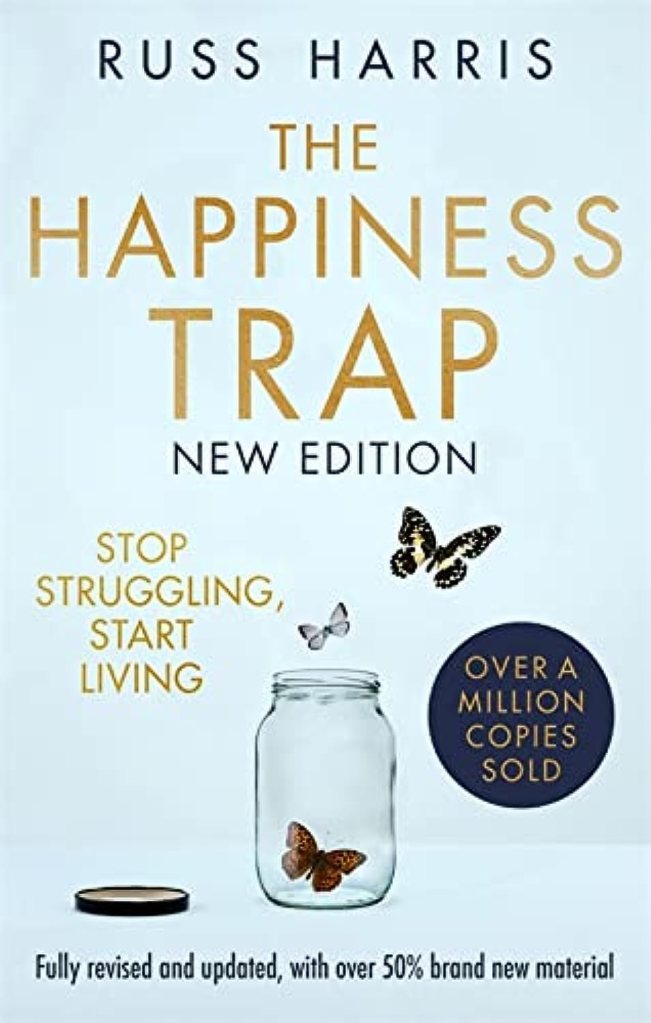
The Happiness Trap was published in 2007. The second edition (the version I read) was published in 2022 by Shambhala Publications and is 300 pages long.
What it’s About
The Happiness Trap is a book in the same vein as self-help, though it’s quite a bit more than that. Written by Russ Harris, it helps to shine a light on the struggle we all have with our brains, specifically, those inner thoughts that only seem to criticise and belittle us.
In The Happiness Trap, Harris teaches us how we might begin to be the masters of our own minds regarding these critical thoughts and how we can live happier, more contented lives by not seeking to have each and every moment of existence filled with joy.
Writing Style
The book opens with the question, ‘Why is it hard to be happy?’ Wherein Harris explores why human beings find it difficult to be content. He also describes the ‘happiness myth’: the idea that happiness is an attainable state of mind we should always strive for. This conventional approach to happiness can often leave us frustrated and unfulfilled since our expectations are often unrealistic. Harris argues that a more productive approach to happiness is to accept the negative emotions and thoughts that arise in our lives, knowing that they are an inevitable part of the human experience.
The book is divided into concise chapters offering a clear structure and a step-by-step process to achieve greater psychological flexibility. It is written straightforwardly and is easy to follow and understand, with Harris explaining his theories and ideas clearly.
One of the essential elements of The Happiness Trap is the concept of Acceptance and Commitment Therapy (ACT), which Harris advocates as an effective way to achieve contentment.
Harris shows readers how to embrace painful emotions and accept them instead of trying to avoid or suppress them. The book extensively covers ‘defusion techniques,’ which help readers to take a step back from negative thoughts and identify them as mere experiences rather than universal truths. This approach allows us to stop reacting to our thoughts and focus more objectively instead on what we want from life. Harris offers a truckload of insightful examples and practical exercises that give readers a clear understanding of how to implement ACT.
Final Thoughts
I loved this book. I was actually recommended it by a counsellor who thought I might benefit from reading it since she thought my attitude towards happiness was similarly geared.
One of the main takeaways from The Happiness Trap is that negative emotions are an inevitable part of human experience and should not be avoided, something which I have and still do struggle with occasionally.
Harris emphasises that attempting to suppress or ignore these thoughts only leads to further distress and struggles with mental health, which makes so much sense to me. Instead, he advocates for accepting our uncomfortable thoughts, feelings and emotions, validating them, and learning to manage them, which I’ve been working on during my own recovery.
I have found The Happiness Trap to be a unique and refreshing approach to the whole concept of happiness and how to deal with those inner voices which seem to want nothing more than to ruin our day.
The book is thought-provoking and practical, showing us how to live a fulfilling and meaningful life. It challenges the conventional wisdom surrounding happiness and provides a refreshing perspective that transcends traditional self-help books. I highly recommend it to anyone seeking a more fulfilling and contented life or those struggling with negative, repetitive thoughts.
I truly believe reading this book will help you look at life a little differently and help you to realise that the ‘happiness thing’ we are all told to want and strive for already exists in our lives if we only really look.
I am giving The Happiness Trap full marks: 10/10.
Have you read The Happiness Trap? What do you think about Russ Harris’ ideas on happiness being more about moments than an overall continuous feeling?
Thank you, as ever, for reading my review. It means a whole lot.
Until next time,
George
© 2024 GLT
Categories: Book Reviews, Reading
 GEORGE L THOMAS
Sounds like a good books to read. Good
for those who are looking for something motivational to read. Thank you for sharing.
LikeLiked by 1 person
Thanks, Fadima!
LikeLike