Hi everyone! I hope you’re all well. Today I am talking about The Iceberg Theory – a totally new concept for me before I fell down one of my usual and many research rabbit holes.
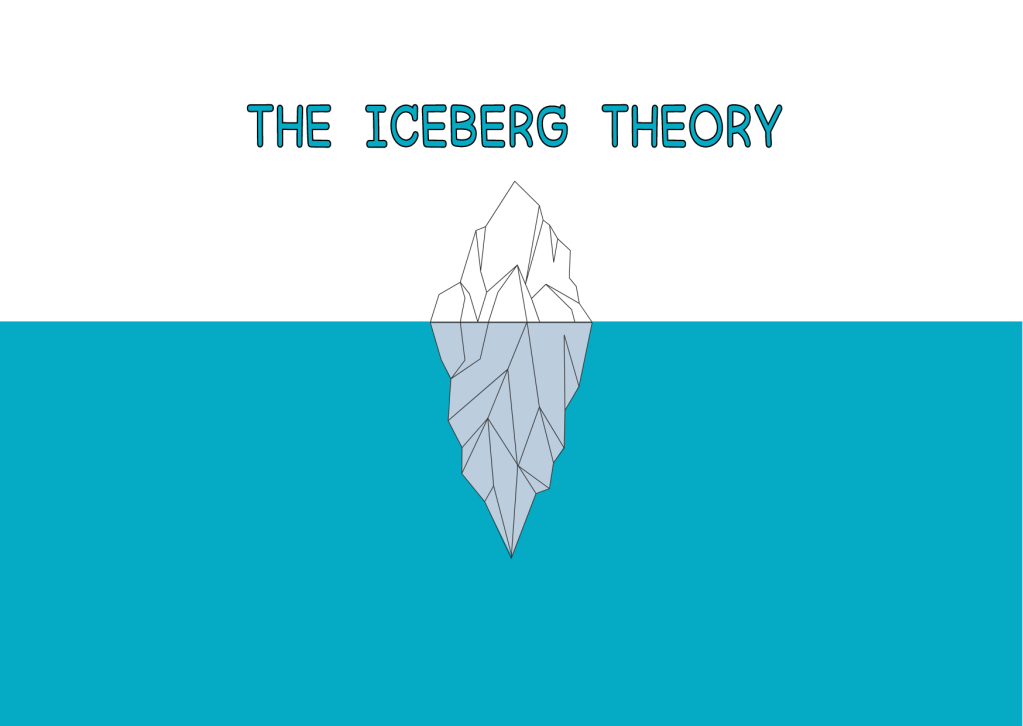
The Iceberg Theory
As writers, we consistently hunt for new and innovative techniques to improve our craft. One such technique I recently discovered is the “Iceberg Theory,” coined by Ernest Hemingway, which has now become an integral part of fiction writing.
The Iceberg Theory suggests that writers should only present the tip of the iceberg to readers in terms of detail while leaving most of the story under the surface (like an iceberg). This means that writers should show only a slim portion of their characters’ emotions, attributes, and thoughts while leaving the rest for the readers’ imagination. This approach allows readers to draw their individual conclusions and recreate their vision of the story in their imaginations.
The theory does not only apply to character development but also to plot and setting. According to Hemingway, writers should not describe every detail of the scene or every nuance of the plot for the reader. Instead, they should offer clues and let the readers grasp what is happening without being spoon-fed.
One of the biggest challenges any writer faces is creating a compelling story that will leave the reader emotionally invested. The “Iceberg theory” is a way to tackle this challenge by allowing the writer to develop a sense of mystery and intrigue that will keep readers hooked until the very end; by leaving out the details, the writer can create a sense of ambiguity that leaves the reader craving more.
Hemingway used this technique himself, often leaving out details that would have given more context to the story. In one of his most famous works, “The Old Man and the Sea,” Hemingway purposely leaves out the backstory of the main character, Santiago. Instead of delivering endless exposition, Hemingway only provides the necessary information, forcing the reader to fill in the blanks.
He believed the writer’s job is only to hint at the underlying information and allow the reader’s mind to do the rest; his unique way of writing has become a benchmark for minimalist writing, with contemporary authors like Cormac McCarthy and Raymond Carver adopting the style in their works.
The Iceberg Theory is particularly effective for creating stories that can be left open to interpretation; a skilled writer can use this technique to create stories that resonate with readers on different levels, ensuring that the story remains relevant and impactful years after it was written.
Using the Iceberg Theory is not always easy, however. Writers must carefully choose which details to reveal and which to hold back. Finding the right balance is essential, as too much information will lessen the impact of your story, whilst too little can leave readers confused and frustrated.
Have you heard about the Iceberg Theory? Have you ever tried it? Let me know your thoughts.
Thank you, as ever, for stopping by and spending time with me today. I appreciate it.
Until next time,
George
© 2023 GLT
Categories: Editing, Writing Tips
 GEORGE L THOMAS
Leave a comment