Hi everyone! I hope you’re all well. Today is Friday, and time for another review. Today, I am reviewing the classic Nineteen Eighty-Four by George Orwell.
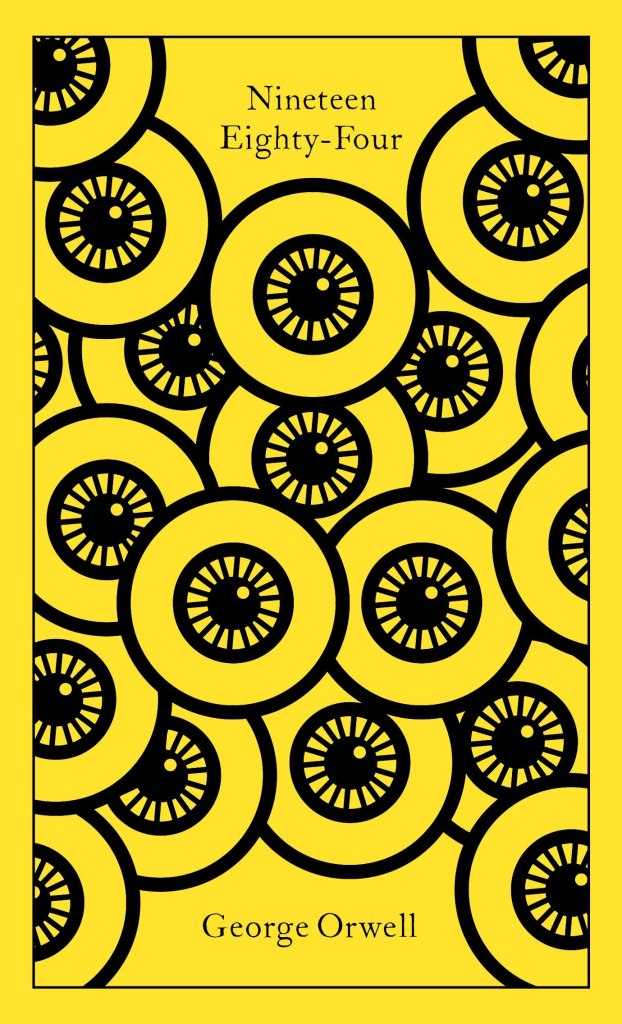
Nineteen Eighty-Four by George Orwell was initially published in June 1949 by Secker & Warburg and (my copy) is 358 pages long.
The Plot
The story follows Winston Smith as he navigates life in the totalitarian state of Oceania, where everything is under “Big Brother’s” control and everything, and everyone is monitored by the “Thought Police”, who ensure that citizens are always toeing the party line and conforming to societal expectations.
Characters
Winston Smith
Winston is the 39-year-old protagonist of the story who works at the Ministry of Truth. He is tasked with rewriting historical documents to create new versions that conform to the government or Big Brother’s narrative.
He is a complex character who feels trapped in a society that has stripped him of his individuality and freedom. Furthermore, he is intelligent and dreams about rebellion even though having such thoughts makes him a “thought criminal”, and he knows he will probably be caught one day.
One day, when Winston is in a “Prole” (lower class) neighbourhood, he meets Mr Charrington, who owns a second-hand shop. He buys a blank book from him and uses it as a diary – a place to keep all of his anti-Party thoughts.
During this time, Winston falls in love with Julia, another rebel against the Party. Mr Charrington rents him the room above his shop so he and Julia can carry out their secret affair.
Winston has long suspected that his superior, O’Brien, is part of a mysterious underground resistance group called the Brotherhood, formed by Emmanuel Goldstein, Big Brother’s political rival. This is confirmed later in the book when O’Brien invites Winston to his flat, introducing himself as a Brotherhood group member. Later on, he sends Winston a copy of a book by Goldstein called The Theory and Practice of Oligarchical Collectivism.
When Winston and Julia read parts of the book, they discover how the Party maintains its power and the meanings behind its slogans. The book explains that the Party can be overthrown if the Proles rise and rebel. Winston, however, does not have the chance to read the whole book leaving some of his questions unanswered.
Inevitably, Winston finds himself unable to escape the grip of the Party; the novel ends with him succumbing to the power of Big Brother after being captured, along with Julia, and tortured for months in an attempt to bring his beliefs in line with the Party.
In a final act of re-education, he is taken to Room 101 (a place containing the worst fear of each prisoner). Faced with a cage full of frenzied rats, he denounces Julia saving himself and pledging his newfound loyalty to the Party.
Julia
Julia is a young woman who also works for the Party. She is far more pragmatic than Winston and is uninterested in overthrowing the Party. Instead, after beginning a love affair with him, Julia uses Winston to satisfy her personal desires and live a life of pleasure and comfort. Although she is not as committed to the rebellion as Winston, Julia is still a significant figure in the novel, as she helps Winston explore his thoughts and feelings and represents a counterbalance to his despair and nihilism. She embodies the ideal of freedom and individuality, and her relationship with Winston represents a hope for a better future. However, her character also highlights the limits of rebellion in a totalitarian society, where the control the Party holds over its citizens is so complete that even the most intimate relationships become politicised.
O’Brien
O’Brien is a member of the Inner Party who fills the role of the archetypal villain. Having tricked Winston into joining the underground resistance movement group known as the Brotherhood, O’Brien shows up later at Winston’s jail cell to brainwash and torture him. During this time, he confesses to Winston that he only pretended to be associated with the Brotherhood, so he could catch him openly betraying the Party.
O’Brien is a character who represents the evil of the Party’s regime through his mastery of propaganda, deception, and torture.
Big Brother
Big Brother is the complete embodiment of the Party’s authority and power and the ultimate symbol of the oppressive and omnipresent government. He is the highest authority figure in Oceania, having supposedly instigated the revolution that brought the Party to power. He has total control over every aspect of society, epitomising the propaganda-driven regime, where truth is manipulated and distorted to serve the interests of those in charge.
Although he is never seen in person, the Party uses the image of Big Brother to create a cult of personality around him, providing a focal point for the citizens of Oceania to pledge their allegiance.
Mr Charrington
Mr Charrington owns a second-hand shop in the prole district of London where he meets Winston and sells him the notebook in which Winston writes his thoughts and feelings about the Party. He also rents Winston the room above his shop where he carries out his love affair with Julia.
Partway through the book, we discover, along with Winston, that Mr Charrington is actually a member of the Thought Police. It turns out that instead of being a fellow enthusiast for the past (something Winston thought he had in common with him), he has, in fact, been setting traps to manipulate and find out rebellious Winston is and how far he would be willing to go.
Emmanuel Goldstein
Emmanuel Goldstein is portrayed as the leader of a group known as the Brotherhood that opposes the ruling power of Big Brother and the totalitarian regime of Oceania. He is seen as a symbol of hope for the oppressed masses.
Throughout the novel, Goldstein’s character remains enigmatic, and our understanding of him as a reader comes primarily from propaganda disseminated by the Party. The Party paints an image of Goldstein as a ruthless and evil individual who seeks to destroy the existing social order and wants to seize power. It is revealed later, however, that Goldstein might not even be a living person, his entire existence having been fabricated by the Party.
Writing Style
Nineteen Eighty-Four is written in a clear, concise style conveying Orwell’s point succinctly, though in an entertaining way.
One of the most remarkable things about Nineteen Eighty-Four is how well Orwell paints the picture of a post-apocalyptic world. He crafts vivid scenes that bring Oceania to life and makes it easy for readers to empathise with Winston as he grapples with his inner turmoil.
Every detail seems so realistic – from the telescreens blaring propaganda messages to the Thought Police who monitor the movements of each citizen – that it is easy to become completely immersed in the world he has created and sometimes even feel the claustrophobia of it as well.
Final Thoughts
Nineteen Eighty-Four is one of the most important works of literature ever written due to its ability to make readers think.
Despite being published over 70 years ago, Nineteen Eighty-Four remains incredibly relevant today due to its timeless themes of government censorship and abuse of power. It serves as a warning about how quickly authoritarianism can take hold if we adhere to the rules without questioning their validity or purpose and how technology can
manipulate people into thinking and feeling what the government want them to think and feel. But it also tells us how individuals can fight against oppressive forces using only their strength of will – no matter how powerful those forces may seem.
The book is an excellent reminder that freedom should never be taken for granted and should always be fought for, even when it seems like all hope is lost. In short, it reminds us that true freedom comes from within ourselves – not from an external force such as a government or leader – and encourages us to think critically about our lives instead of accepting things at face value.
I highly recommend reading Nineteen Eighty-Four if you have not already done so, and I am giving it a 9/10.
Have you read Nineteen Eighty-Four? What did you think of it?
As always, thanks for taking the time to check out my review. I really appreciate it.
Until next time,
George
© 2023 GLT
Categories: Book Reviews, Reading
 GEORGE L THOMAS
Leave a comment